
Screen Economy Reset, Reallocation Are Real and Now, Says Vivek Couto at APOS
Artificial intelligence is changing production and consumption; retail media is the biggest growth vector; market is concentrating in hands of few.

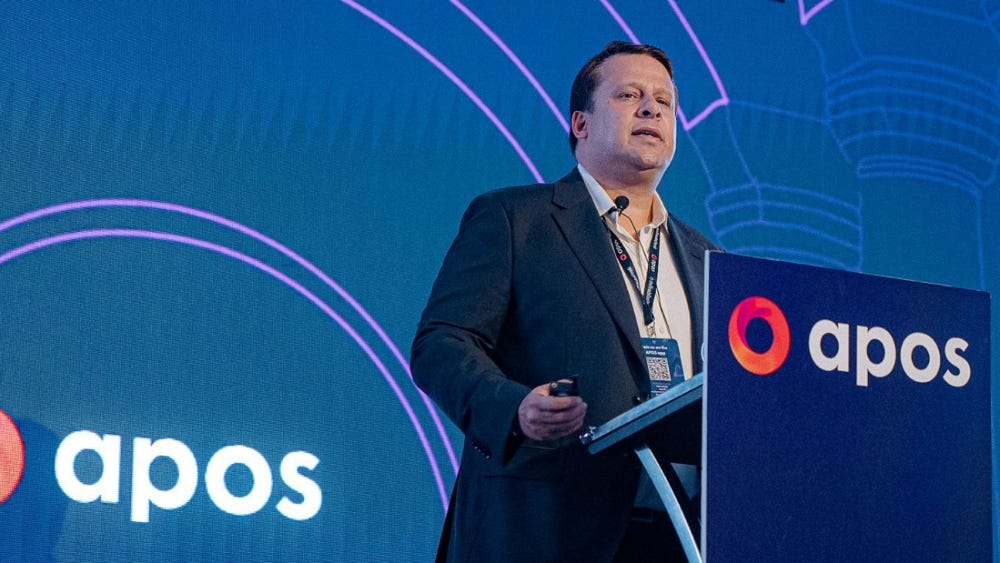
Vivek Couto, managing partner of Media Partners Asia, kicked off the APOS conference on Wednesday with an analysis that he called a runway in Asia, but also reads like a warning not to get left behind.
“I have titled this opening The Screen Economy Reset because this it is not disruption. It is a story about reallocation. Four forces are reshaping our industry.
Asia Pacific is the largest and youngest screen base on the planet, on its way to 5.2 billion screens by 2031.
The second is monetization: the high growth is moving to retail media and commerce. The third is convergence: video, social and commerce are no longer separate businesses; they are collapsing into the same platforms. And the fourth is intelligence with AI resetting the cost of content, the speed at which it travels, and the languages it travels in.
Almost every dollar of that new revenue is digital — premium streaming, social and user-generated video, and micro-drama,
APAC has roughly 55% of the planet’s screens and about a quarter of its revenue. Scale concentrates in three markets — China, Japan and India anchor the region, with China alone approaching $100 billion.
And the growth concentrates too. over the next five years, China contributes the most, India the most outside China, and in every single market the digital gains more than absorb television’s decline.
None of this is possible without connectivity, and connectivity in our region is a tale of two speeds. Ex-China, mobile subscriptions climb past 2.4 billion, and 5G moves from the margins to roughly two-thirds of the base within the decade. In India and Southeast Asia, the mobile network is still the primary way people reach video — and, increasingly, the bridge onto the big screen.
On that mobile-first base, a new format is taking shape: vertical, bite-size micro-drama, built for the phone rather than retrofitted to it. The category is still in its infancy, but a wide field of players is already testing it.
In Japan and Korea, the networks are effectively saturated, so the contest there is no longer about reach at all. It is about speed, bundling and monetization.
Arguably, the most important screen in that monetization story is the one in the living room. Connected-TV homes ex-China more than triple over the decade, from under 80 million to more than 250 million, as smart-TV prices fall and home broadband deepens. This matters for two reasons. It improves the product, because big-screen viewing is more engaged, more premium and more valuable. And it improves the advertising.
In subscriptions, one long debate is now settled. Streaming has passed pay-television and is not looking back — SVOD overtook pay-TV subscriptions back in 2022, and by 2031 it out-subscribes pay-TV by more than five to one. This phase is powered by something far harder to copy, product quality, local relevance, and live sport.
Pay-TV is not collapsing; it is in a managed decline. India adds 366 million subscriptions over the decade, more than the entire rest of APAC ex-China combined.
Bundling has gone from a marketing tactic to a structural pillar of the market. In India, Indonesia and Thailand it is, quite simply, how the market expands at all; and in Australia, Japan and Korea it is how the mature platforms hold their subscriber bases together.
The consumer is still spending — the wallet is robust — but it has been repriced. Ex-China, household video spend grows steadily, and inside that total, streaming is replacing pay-TV almost dollar for dollar.
The money has not left the industry. It has changed hands, from a high-margin television dollar to a lower-ARPU digital one.
Advertising, is the most contested, and the most uncertain, part of the entire outlook. 2026 is the slowest year for APAC advertising since the pandemic, growing just over five percent. Television advertising will fall again. Digital will grow and now takes three-quarters of every ad dollar in the region.
The growth is accruing to a small handful of platforms with scale, targeting and pricing power — YouTube, TikTok, Meta.
Premium ad-supported streaming — the ad tiers from the SVOD platforms, and the broadcaster-backed services — is the only premium video advertising line that is actually growing, led by India and Japan, and proven out in Australia and Korea.
This is the most important message today. Money follows platforms that can close the loop.
APAC digital advertising nearly doubles across the decade, but the fastest-growing line within it is not video advertising at all. It is retail media. Advertising attached directly to a purchase. The logic is simple: a platform that can connect attention to a transaction captures the budget, and a platform that can only deliver attention ends up renting its reach to the one that can.
And this is not a one-market phenomenon, or some China peculiarity. Retail media leads the advertising increment in every major market — China, Japan, India, Southeast Asia, Australia and Korea.
New formats are reshaping engagement from below. Start with micro drama. China is already an $11-to-17-billion growth market in this format alone. Ex-China, it is around $3 billion today, and on course to triple.
The economics are harder than the growth chart suggests, and they tell you something important about this whole era. Micro-drama is hits-driven, and its dominant cost is not production. It is marketing. Paid user acquisition can consume the majority of revenue. These businesses live or die inside very short ROI windows, a title often has to earn back its spend in 48 to 72 hours, or the marketing is switched off.
Two operators have made this model work at scale . Between them, ReelShort and DramaBox account for close to half of all ex-China micro-drama revenue today, and they have begun to convert that scale into genuine, if still thin, profit margins.
Two forces are now rewriting the math. The first is AI. The second is genre.
Two forces are now rewriting the math. The first is AI. In China, close to 40% of the top 100 micro-drama chart is already AI-generated; Douyin saw tens of thousands of AI-native titles in a single month, produced at a fraction of live-action cost.
The second is genre. The format is breaking out of the romance-and-billionaire template into thriller, horror, fantasy and local-language storytelling
China shows us the destination early. Here, short video, social and premium long-form already sit inside the same five companies and the platforms that began in short video and social now earn more from video than the dedicated streamers do.
Every major Chinese player runs a hybrid stack: social feeds, short clips, micro-dramas, and full-length premium series under one unified user account and recommendation engine. ByteDance and Kuaishou alone capture nearly half of the total national video market share.
Tencent holds a combined 27% share by pairing its social short-form WeChat Video Account with premium long-form streaming on Tencent Video, while standalone premium specialist iQIYI accounts for an additional 10%.
And the clearest sign of that convergence is the creator economy, which has now drawn level with premium streaming for attention. On revenue, premium streaming still holds its ground. So, creators have already won the attention. The only question left is the money.
China is the benchmark and in a scale of its own at roughly $20 billion of creator and influencer ad spend, sitting on top of close to $500 billion of creator-driven commerce, with a hundred million creators on a single platform.
But the most instructive market is Southeast Asia. There, influencer advertising is around $2 billion— while the creator-driven commerce behind it is roughly $50 billion. So, the commerce layer is more than twenty times the advertising layer.
The money is not in the ad beside the content. It is in the transaction inside it.
India is the mirror image — 150 million creators, the fastest growth in the region, and so far the least money. Audience without revenue.
Japan, Korea, Australia — are smaller and more specialized, built around VTubers and anime IP, virtual influencers and K-content export, brand-safety and compliance. And the conclusion is the one we keep arriving at from every direction: reach is not revenue until you build the rails to the transaction.
Ex-China, just three platforms — YouTube, Meta and Netflix — take more than half of all online-video revenue. The long tail of the open web is real, but the economics live at the very top of the table.
And yet, the local champions are rising. JioHotstar in India, U-Next and TVer in Japan, TVING and Wavve in Korea, Vidio in Indonesia, Viu across Southeast Asia — in every major market, the strongest local platform is gaining share against global scale, by pairing local content and sport with smart bundling.
In India, JioHotstar surpassed $1 billion in revenue last year and is on track to surpass YouTube in total revenue by the end of this year.
Where did the value actually end up? On one side, the attention and platform giants — Meta, ByteDance, Tencent, YouTube — are worth around $3 trillion between them. On the other, the entire studio-and-streamer establishment — Netflix, Disney, Warner, Paramount — comes to roughly $600 billion. That is a five-to-one gap.
And the single most valuable entertainment company on earth today is private, Chinese and vertical-first.
Of the ten most valuable retail and e-commerce companies in the world, nine are Asian. And one company — ByteDance — appears on both lists, the entertainment list and the commerce list, because for ByteDance they are not two businesses. They are one.
This finally leaves the fourth force: Intelligence.
AI works on both sides of the income statement.
AI is almost always discussed as a cost story — cheaper dubbing, cheaper production. It is that. But it is far more,: this is the first technology cycle that works on both sides of the income statement at once. It lowers cost, and it lifts revenue. And it is already showing up across four engines of this business storytelling, streaming, broadcasting and advertising and in sports.
The pattern is becoming embedded in the operating fabric of this industry but the model that wins is hybrid: AI leads on volume and speed, while humans hold the emotionally nuanced work.
Intelligence is a requirement and not an enhancement. This is the five-year ledger for premium video in APAC, ex-China.
On the advertising line, television loses around 3.6 billion dollars while streaming adds about 3.3 billion — so the net is essentially flat. On consumer spending, pay-TV loses close to 3 billion while streaming adds more than 5 — a net gain of a little over 2 billion. Put the two together, and premium video grows, across five whole years, by barely 2 billion dollars. And against that thin sliver of new revenue, content costs rise by more than 3 billion. In our models, the only content lines still growing are streaming and at a marginal level, film or theatrical. Free-TV and pay-TV content spend are both falling — and yet the total bill still climbs.
So hold the two numbers side by side. Roughly $2 billion of new revenue. More than $3 billion of new cost. The top line is not going to save the margin.
And this is where it gets engineered. We size the prize what we call the intelligence dividend at $9-15 billion a year, ex-China, by 2031.
The largest gain is production efficiency — a 15-to-25% saving on a roughly $31-billion content base — worth between $4.6 and $7.7 billion.
Then ad-yield uplift — 5-10% on a $35-billion online-video advertising pool — adding another $1.8-$3.5 billion.
Then video commerce, then personalization and retention, then localization. The base case lands at around $12 billion a year.
And because AI rewards scale — better data, lower unit costs, faster monetization — it will widen the gap between the platforms that can industrialize it and those that cannot.
This dividend is paid only to those who industrialize AI without spending their audience’s trust. The cost savings are real, and they are bankable. The trust is the constraint.
So let me leave you with five things to remember.
First: the biggest audience is not the biggest business. We earn a small fraction per head of what the US earns and that gap is the upside, not the verdict.
Second: the subscription crossover is finished. The next gains come from pricing, bundling and ad tiers, not from new subscribers.
Third: reach is not revenue until you build the rails beneath it. Turning attention into a transaction is engineered, never automatic.
Fourth: creators and micro-drama now rival premium streaming for attention — and commerce no longer wants to advertise around the content; it wants to own the format.
And fifth: AI is a $10-to-15-billion dividend and, for the first time in our industry, efficiency is a growth strategy rather than a cost line.”
The reset is not coming. It is here.
Amazing insights. Our world is being transformed and Asia is leading the way.